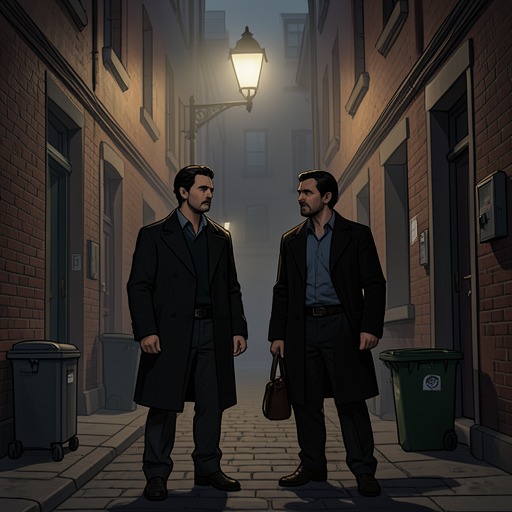
Jim
Naked LunchJim is Brad’s partner in an embedded romance that first promises escape from crime and insecurity, then overturns its domestic happy ending with grotesque violence. His story moves from a chance meeting in jail to shared work and a home on the Lower East Side, where threats to the couple’s life together are answered by a brief, comic tableau of mutual affection and a final meal that makes the apparent resolution impossible to take at face value.
Introduction and Meeting
Jim enters through a melodramatic sequence in which Brad draws a deuce and meets him in jail. The narrative presents their attachment in deliberately qualified terms: love begins, or at least a facsimile of it convinces both parties. When they are released at roughly the same time, they establish a home together in a Lower East Side flat. Both cook, and both take modest legitimate jobs. The account calls this the first time Brad and Jim know happiness, giving their shared work and ordinary domestic routine a forceful contrast with the criminal world surrounding them.
The relationship is framed less through a detailed account of how the two change than through a compressed series of romance conventions. They meet under confinement, leave together, and attempt a respectable life. The phrase “or at least a facsimile thereof” keeps the love story at an ironic distance: the narrative offers a recognizable romantic arc while openly drawing attention to its own artificiality.
Pressure on Their Shared Life
The couple’s new stability is tested by two separate offers that point in opposite directions. Lucy Bradshinkel arrives to say that all is forgiven and expresses faith in Brad, offering to establish him in a studio. The arrangement carries a condition: Brad would have to move to the East Sixties. Lucy dismisses the existing home as impossible and makes clear her displeasure with his friend. Her offer is therefore not simply material assistance; it would also separate Brad from Jim and displace the life they have made together.
At the same time, a safe mob wants Jim back as a driver. The work is presented as a step up, and the offer comes from people who scarcely know him. Jim is thus confronted with renewed access to crime, while Brad is tempted by an apparently advantageous alternative to their shared home. The narration asks whether Jim will return to crime and whether Brad will yield to Lucy’s blandishments, but it supplies no extended account of their private deliberations. Instead, it resolves the suspense summarily: the forces of evil are routed, leaving behind ominous threats and muttering. The outcome establishes that neither offer breaks the partnership in this episode.
Partnership and Domestic Tableau
After the threats have receded, Jim and Brad stand together at a tenement window, arms around each other, looking toward the Brooklyn Bridge. This image turns their modest residence into the setting for a conventional promise of shared domestic life. The spring wind ruffling Jim’s black curls and Brad’s hennaed hair adds a seasonal note of warmth, while the bridge gives the closing tableau a visible urban horizon. Their intimacy is public within the scene: they stand together, not apart, after both have been pressured toward different lives.
Their brief exchange about supper shifts the scene from romance to everyday domestic comedy. Jim asks what is being served; Brad playfully sends him out of the kitchen and puts on an apron. The gestures suggest familiar ease and a division of household activity, not a new conflict. The narration then names the meal as Lucy Bradshinkel’s body prepared in an elaborate, grotesque dish. That revelation recasts the preceding rejection of Lucy’s offer: the apparent romantic victory is inseparable from an act of horrific retaliation, though the passage does not explain how the meal was obtained or describe the act itself.
The couple eat happily while looking into each other’s eyes. The closing image of blood on their chins makes the domestic scene both an apparent consummation of their bond and a deliberate rupture of sentimental convention. Jim is not shown questioning the meal or its origin; the text gives the reader the startling image without supplying his thoughts. The gap between the lovers’ composed happiness and the disturbing fact of what they are eating is central to the scene’s effect.
Narrative Function and Ending
Jim’s role is defined by the partnership’s resistance to external pressure and by the way the episode uses that resistance to stage a parody of romance. Lucy’s offer would draw Brad away, while the mob’s proposal would return Jim to criminal work. Their shared appearance at the window indicates that the couple remains together after these competing pressures, and Brad’s preparation of supper gives their reunion the familiar shape of a domestic ending.
That ending is deliberately unstable. The threats are declared routed, the pair share a home and a meal, and the scene briefly supplies the signs of a happy future; yet the meal turns Lucy’s disappearance from the couple’s life into the grotesque material of their apparent contentment. Jim’s story therefore does not offer an uncomplicated celebration of domestic security. Its sentimental images are retained only to be made disquieting, exposing the distance between a conventional romance resolution and the violent world the episode makes visible.